
What that “crack” sound really means (and it's not what you think)
You are sitting in the chiropractor's chair. You feel a firm pressure on your back, a quick movement, and then: Genius! A loud sound, almost as if something broke. But instead of pain, you feel relief. Your back feels lighter, as if a weight had been lifted off it.
What exactly happened there? Did a bone “settle”? Did something get "unlocked"? Why does it hurt so little if it sounds so loud?
Here's what most people don't know: That popping sound doesn't mean something has settled into place.. And it doesn't indicate that the adjustment was “successful.” It is a completely different physical phenomenon that almost no one explains well.
Even more surprisingly, highly experienced professionals can make equally effective adjustments. without making a sound. Noise is not the goal, it's just a side effect. And understanding this completely changes what you will expect from your next visit.
Keep reading. I'm going to explain exactly what happens in your body during an adjustment, what it feels like step by step, how long a real session lasts, and at the end I'm going to reveal the key difference between a professional chiropractor and a “bone cracker,” a distinction that could be the difference between healing your back or injuring it.
What is really a Back adjustment?
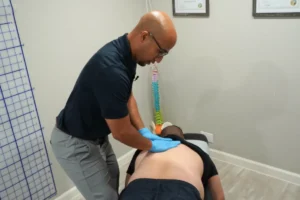
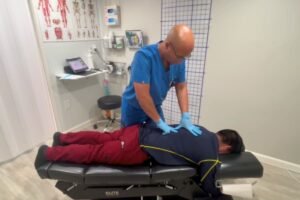
A Back adjustment (also called chiropractic adjustment, spinal manipulation, or thrust) is a manual technique where a professional applies a Specific, fast, and controlled strength about a spinal joint that is restricted or misaligned.
The technical term is HVLAHigh-Velocity, Low-Amplitude (HVLA) thrust. “High-velocity” because the motion is very fast. “Low-amplitude” because the motion is small, not a large twist or strong pull.
What is a fit looking for?
According to established clinical practice, an adjustment has three main objectives:
- Restore joint mobility. When a vertebra loses its normal range of motion (gets “stuck”), an adjustment releases that blockage.
- Reduce pressure on nearby nerves. Misaligned vertebrae can irritate nerves that exit the spine.
- Improve communication between the nervous system and the rest of the body. A well-moving spine allows nerve signals to “flow” better.
What a fit No es:
- It's not “bone setting” (vertebrae are not “out of place” like a LEGO brick).
- It's not breaking anything.
- Do not stretch the spine forcefully.
- It is not a massage.
- It doesn't depend on “popping” your back.
The famous “crack”: what is it really?
Here's the truth that's going to change the way you see settings.
That “crack” sound is called cavitation. And no, it's not the sound of bones cracking or something settling. It's something much more interesting.
The Science Behind Sound
Your joints have a lubricating fluid called synovial fluid. It's like oil that keeps a hinge moving without squeaking. Dissolved gases (mainly nitrogen, oxygen, and carbon dioxide) are contained within this liquid.
When the chiropractor applies the adjustment, the pressure inside the joint changes rapidly. That change in pressure causes dissolved gases to form tiny bubbles that collapse or release suddenly. That collapse is what produces the “crack.”.
It's the exact same physical phenomenon as when you crack your knuckles.
What sound does NOT mean
This is key: The sound does not indicate that the adjustment was successful..
- A fit can be very effective without making a sound.
- A fit can sound loud and not having been in the right place.
- People with a lot of synovial fluid pop more; others with less pop almost not at all.
- After an adjustment, you won't be able to “crack” the same joint again for 20-30 minutes because the gases need to replenish.
As the Dolorfin clinical team confirms, “the characteristic sound during an adjustment is called cavitation and is produced by the release of dissolved gases in the joint fluid. It does not indicate that something has ‘settled,’ and its presence or absence does not determine the success of the technique.”
So, why do people feel better afterward?
Real improvement comes from:
- The Joint mobilization (sound isolated).
- The reflex muscle relaxation that surround the joint.
- The reduction of nerve irritation local.
- The better circulation in the treated area.
The “crack” is just background music. What really matters happens silently within you.
Does a back adjustment hurt? The question almost everyone asks
If you're wondering My lower back hurts., This is the clear answer based on clinical practice:
In most cases: It does NOT hurt
A well-performed fitting by a trained professional is:
- Fast seconds
- Need at the exact point
- Amazing more than painful (the sound or movement might impress you, not the pain)
Many people describe the feeling as “immediate relief,” “a release,” or “pressure lifting.”.
When can you feel some discomfort
There are situations where the adjustment can cause mild discomfort:
The area was already very swollen or irritated. If you arrive with a sharp whiplash or a very recent hernia, the sensitive tissues can cause discomfort with any touch.
There's a lot of built-up muscle tension. When muscles are very contracted, the adjustment may cause an uncomfortable, not painful, sensation before relief.
3. It's your first adjustment, and you're tense. The patient's tension (because they don't know what to expect) causes the muscles to resist. This can cause more discomfort than the adjustment itself.
4. You have “sore muscles” afterward. The day after an adjustment, some people feel soreness similar to post-exercise soreness. This is completely normal and lasts 24-48 hours. Your body is adjusting to its new mobility.
What you should NEVER feel
- Sharp or electric pain during adjustment
- Pain that progressively increases after
- Pain in other areas that were not treated
- Numbness or tingling
- Pain lasting longer than 48 hours
If you experience any of these, report them to your professional immediately.
The adjustment compared to other techniques
For your reference:
- Softer An intense sports massage session
- Faster that a deep stretch
- Less invasive An infiltration
- More controlled any traditional “thunderer”
Is chiropractic adjustment safe: what the evidence says
Perhaps the most important question of all: Is chiropractic adjustment safe?
The short answer based on available clinical evidence: Yes, when performed by a professionally trained individual after an appropriate assessment.
Why is it safe
It is a procedure without medication. There are no pharmacological side effects, no interactions with other treatments, and no liver or kidney damage from prolonged use.
2. It is non-invasive. There are no incisions, no needles, no surgery. The body does not need to “recover” from an external intervention.
3. It is reversible. If for some reason an adjustment didn't work as expected, there's no permanent damage. The body simply returns to its previous state.
4. It is performed after evaluation. A serious professional does not adjust you without first evaluating you. This includes medical history, physical examination, and, if necessary, imaging studies.
The real risks (which do exist)
Let's be honest: no treatment is 100% risk-free. The most common side effects are Light and transient:
- Mild muscle discomfort (similar to muscle soreness) in 30–40% of the patients
- Feeling of fatigue on the day of adjustment
- Mild headache (especially with neck adjustments)
Serious risks are rare when the fitting is performed by a trained professional and following adequate evaluation. Serious complications are documented, but are extremely rare in regular professional practice.
When is an adjustment not safe
There are situations where adjustment is contraindicated or requires many precautions:
- Severe osteoporosis (very brittle bones)
- Recent fractures unhealed
- Active infections in the column
- Tumors vertebral
- Severe vertebral instability
- Some herniated discs with progressive neurological signs
- Coagulation disorders The use of anticoagulants (on a case-by-case basis)
- Aneurysms abdominal or aortic aneurysms
An ethical professional will honestly tell you when an adjustment isn't the right option for your case.
The difference between a professional chiropractor and a “bone cracker”
Here's a key distinction that many people don't know:
Professional chiropractor:
- She has several years of university education.
- Performs clinical evaluation before any adjustment
- Know contraindications and red flags
- Knows when to refer you to another specialist
- Make specific adjustments in specific areas
- Works in clinics with biosafety protocols
“Bone setter” or “adjuster” without training:
- He learned techniques through imitation, not clinical training
- It does not evaluate before manipulating
- It does not have contraindications
- He makes general movements, without precision
- It can cause serious injuries
The Dolorfin team warns: “It's important not to confuse [professional adjustments] with non-professional techniques such as so-called ‘bone crackers’ or bone adjusters, who lack clinical training or prior assessment.”
When in doubt, always verify the credentials of the person handling your spine.
How Long Does a Chiropractic Adjustment Take: Real Timings
If you're wondering How long does a chiropractic adjustment last, there are two answers: how long the adjustment itself lasts (the movement), and how long the full session lasts.
The adjustment itself
Seconds. The adjustment movement lasts less than a second. It's a quick, controlled impulse, not a sustained movement.
That's why many new patients are surprised: “Already? That was it?” Yes, that was it. The speed and precision are what make it effective.
The full session
First visit: 45-60 minutes
Your first query is the longest because it includes:
- Detailed medical history (10-15 min)
- Physical examination and functional tests (10-15 min)
- Review of previous studies if you bring them (5 min)
- Discussion of findings and treatment plan (10 min)
- Treatment (if applicable on the same day) (10-15 min)
Follow-up visits: 15-30 minutes
Regular sessions include:
- Review of how you've been feeling since your last visit (3-5 min)
- Quick assessment of current status (3-5 min)
- Treatment: adjustments, muscle therapy, complementary techniques (10-20 min)
- Recommendations for home (3-5 min)
How many sessions do you need
This depends on your case, but as a general reference:
Mild cases (recent pain, minor injury):
- 4-8 sessions
- 1-2 sessions per week
- Total duration: 3-6 weeks
Moderate cases (months of pain, whiplash, sciatica):
- 12-20 sessions
- 2-3 sessions per week at the start, then 1 per week
- Total duration: 2-3 months
Chronic cases (years of pain, structural problems):
- 20+ sessions
- Decreasing frequency over time
- Total duration: 3-6 months or more
Maintenance (optional):
- 1 session every 4-8 weeks
- To prevent relapses and maintain well-being
Be wary of professionals who promise “one session and you're cured” or who prescribe eternal treatments without clear objectives. A good chiropractor will explain from the beginning what to expect, approximately how many sessions, and how you will see improvement.
What happens in your body during and after an adjustment
So you know exactly what to expect, here's the step-by-step of a typical session:
Before adjustment
- You are positioned on a special examination table, usually face down or on your side.
- The chiropractor palpates your spine to feel for restricted areas.
- It explains what it's going to do and what you're going to feel.
- It asks you to breathe and relax.
During the adjustment
- It places you in a specific position to reach the segment that needs correction.
- Apply initial pressure (it's not the setting yet).
- In a swift move, apply the adjustment thrust.
- The “crack” can be heard or not.
- In seconds, it all ends.
Immediately after
Some people feel:
- Immediate relief: feeling of “space” or “freedom” in the treated area.
- Feeling of relaxation The muscles around the joint relax.
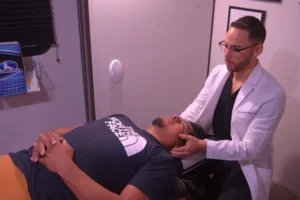
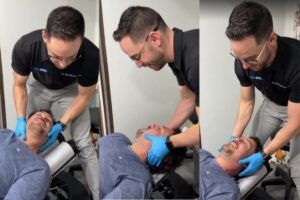
- Slight momentary dizziness: especially with neck adjustments. It happens in seconds.
- Heat in the area due to increased circulation.
- More mobility: Notes that you can rotate or move better.
The following hours
- General feeling of well-being.
- Sometimes mild fatigue (your nervous system is recalibrating).
- It is recommended to drink water, walk gently, and avoid exertion.
The next day
- Some people feel a Soreness like “DOMS” in the treated area. It is normal and lasts 24-48 hours.
- Others simply feel the sustained improvement.
- It's important to maintain light movement (walking, stretching) to consolidate the fit.
What to do (and NOT to do) after an adjustment
To get the most out of it:
YES do
- Walk 10-15 minutes after adjustment. Movement helps “settle” the changes.
- Drink water. The spinal discs and tissues need hydration.
- Apply heat if you have mild muscle discomfort.
- Maintain good posture for the rest of the day.
- Sleep well. The body consolidates changes during sleep.
- Do the exercises What did your chiropractor recommend?.
Don't do it
- Don't lift heavy objects the first 2-4 hours.
- Don't exercise intensely The same day (running, weights, high-impact sports).
- Don't sit for too long or in a forced posture.
- Don't “mess with” yourself the back or the neck.
- Don't drink too much alcohol. the same day (dehydrates tissues).
- Don't get frustrated if you don't feel immediate improvement. Some changes are progressive.
Common myths about adjustments that deserve to be debunked
Myth 1: “If I get fitted once, I'll become dependent.” False. The body does not become “addicted” to adjustments. What happens is that many people perceive improvement and choose to continue with a maintenance plan because they like how they feel.
Myth 2: “The adjustment can paralyze you.” The risks of serious complications are extremely rare when adjustments are made by a properly trained professional. The actual figure is well below the risks associated with commonly used anti-inflammatory medications.
Myth 3: “It only works for back pain.” Although very useful for back pain, adjustments also help with neck pain, tension headaches, sciatica, cervical vertigo, joint mobility issues, and more.
Myth 4: “If it thunders loudly, the adjustment was better.” False, as we already saw. Sound is not indicative of success.
Myth 5: “I can crack my own back and fix myself.” False and dangerous. When you “crack” yourself, you are moving joints that Yeah They move, not the ones that are blocked. In the long term, this can cause hypermobility and worsen the problem.
Myth 6: “It's magic or pseudoscience.” False. The effects of spinal manipulation are explainable by documented physical and neurological mechanisms.
Myth 7: “Once adjusted, I'll never have pain again.” It's not realistic. The body is dynamic and problems can return if the habits that caused them aren't changed. Adjustments provide relief, but habits prevent issues.
The key difference between a chiropractic professional and a “thunderer”
I promised you at the beginning. Here it goes.
The difference between a professional chiropractor and a “bone cracker” comes down to one word: EVALUATION.
A professional chiropractor
- It assesses you before touching you. Medical history, physical exam, functional tests, sometimes X-rays.
- It explains what you have and what it's going to do. They don't treat you like just another body in line.
- Adjust specific points identified in the evaluation. It doesn't make “general adjustments” to everything.
- You know when NOT to adjust. Recognize contraindications and red flags.
- We will refer you to another professional if your case requires it. Don't try to be an expert in everything.
- Has verifiable credentials. University degree, professional registration, continuing education.
An untrained “thunderer” or “accommodator”:
- It blasts you without evaluating. “Lie down, this is what you need.
- Apply force without precision. Broad, non-specific movements.
- It has no contraindications. You might unknowingly adjust someone with osteoporosis, a fracture, or an aneurysm.
- It doesn't recognize emergencies. You can manipulate someone who needs an urgent MRI.
- It has no way of responding to complications. If something goes wrong, he doesn't know what to do.
Before any adjustments, ask these questions:
- I am a large language model, trained by Google.
- What is your registration or license number?
- How are you going to evaluate me before the first adjustment?
- Have you handled cases like mine before?
- What happens if my case is not suitable for adjustments?
An ethical professional answers these questions calmly. Anyone who gets upset or evades is a red flag.
Summary to remember the essentials
- A Back adjustment It is a precise manual technique that restores joint mobility and relieves pressure on nerves.
- The famous “crack” is cavitationRelease of gases from synovial fluid. No It doesn't indicate success nor does it mean something settled.
- ¿My back adjustment hurtsIn most cases, no. There can be mild soreness, similar to “DOMS” (delayed onset muscle soreness), afterward, which lasts 24-48 hours.
- ¿Is chiropractic adjustment safeYes, when performed by a trained professional after a proper evaluation. Serious risks are rare.
- ¿How long does a chiropractic adjustment lastThe movement lasts seconds. The first full session is 45-60 minutes. Follow-up visits are 15-30 minutes.
- The difference between a professional chiropractor and a “bone cracker” comes down to assessment, training, and credentials. Always check.
Your spine is the structure that supports your daily life. Treat it with the respect and information it deserves, and it will put the rest of the work on your side.
This content is for informational purposes only and does not substitute professional medical advice. Before beginning any manual treatment, ensure you are evaluated by a properly credentialed and trained chiropractor.