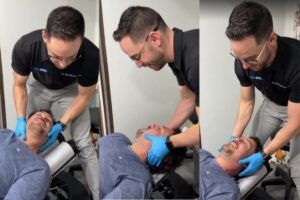

The decision many Hispanics make without knowing what to look for
Your back has been giving you trouble for weeks (or months, or years). A friend recommends a chiropractor. You search on Google. 30 options appear. Some have 5-star reviews, others 4-star, others no reviews. Some promise “relief in a single visit.” Others seem like serious professionals but don't speak Spanish. And amidst all that, you just want to know: Which one is good?
Here's what most people don't tell you: finding a good chiropractor isn't about who's closest, or who has the prettiest office, or even who promises the fastest results. It's about 6 very specific signs What distinguishes a good professional from one who can waste your time and money, or worse, injure your spine.
And there's a fact that the Latino community rarely hears: in many US states, there are people offering “chiropractor-like” services without a license or certification. The California Board of Chiropractors, for example, specifically warns that you can file complaints against “Individuals without certification providing or offering chiropractic services”. This means that the problem is real and officially recognized.
Keep reading. I'm going to give you the 6 signs that indicate you've found the right chiropractor, the exact questions you should ask before you start, and at the end, I'll reveal the most underestimated red flag, the one that many patients notice but ignore because “I already paid for the consultation.” This is information that can save you time, money, and protect your health.
Why does it matter so much to find a Recommended chiropractor in Spanish
Before the signs, it's worth understanding why the specific search for a Recommended chiropractor in Spanish is so important to the Latino community:
Clear communication is treatment. In medicine, what isn't understood isn't followed. When your healthcare professional can't clearly explain what you have, what they're going to do, and what to expect, outcomes are affected. It's not a luxury, it's a necessity.
2. The nuances of pain matter. “It burns, it pricks, it pulls, it tingles”: each word describes something different and guides the diagnosis. In your own language, you can be more precise.
3. Trust accelerates improvement. When you feel culturally understood, you open up more, follow directions better, and get results faster.
4. The US healthcare system is complex. Workers' compensation, health insurance, car accidents, appointments, forms: everything is easier when the professional speaks your language and understands your context.
5. Latin culture has particularities. Jobs with many hours on your feet, carrying heavy objects, awkward postures in construction, restaurants, cleaning, agriculture, elder care. A chiropractor who understands this will treat you better.
Find someone who matches vocational training + communication in Spanish + cultural awareness It's the winning combination.
The 6 signs that indicate you found the a qualified chiropractor
Sign #1: Has verifiable credentials and is happy to show them
This is the most important sign of all. A professional chiropractor:
- Has a Doctor of Chiropractic (DC) degree, obtained after several years of university study.
- She holds a valid license in the state where she practices.
- You have passed the National Board of Chiropractic Examiners (NBCE) exams, which consists of several parts over the years of study.
- Can pass background checks. In California, for example, the Board of Chiropractors requires that certified practitioners “undergo a background check to confirm that they have no criminal convictions.”.
How to check it
- Ask to see the title and license (they are usually framed in the clinic).
- Check your state's public registry of chiropractors online (most states have a public database).
- Look up their name on official health platforms.
- What is your license number?.
Red flags:
- He evades the question about his education.
- He gets annoyed when you ask for credentials.
- You claim to be a “chiropractor” but only took “short courses” or “weekend courses.”.
- Works without a proper professional space.
- It has no official presence in state records.
Sign #2: Conducts a comprehensive evaluation before any treatment
As Univision highlights in its wellness guide, “a professional and trustworthy chiropractor will provide a free consultation or evaluation prior to treatment, during which they will give their recommendations in writing and their assessments, determining whether treatment is necessary or not.”.
A good professional:
- Interview me calmly about your medical history, symptoms, previous injuries, medications.
- Performs a complete physical examination: Evaluate posture, mobility, muscular strength, reflexes.
- Perform specific functional tests to identify the origin of the problem.
- If necessary, order imaging studies (X-rays, MRI) before starting treatment.
- It will provide you with the findings in writing. and it explains a clear plan to you.
Red flags:
- It adjusts on the first visit without prior evaluation.
- “I know what you have” without having touched you.
- It's not asking about your medical history.
- Treat all patients with the same protocol.
Sign #3: Explains everything to you in plain language and answers your questions
A truly professional chiropractor it treats you like an intelligent adult, not as “just another customer.” This means:
- It explains what was found in the evaluation In words you understand.
- It tells you what it's going to do and why before I touch you.
- It explains what you will feel during the treatment.
- Take your time answering your questions.
- He doesn't use medical jargon to impress you.; If a technical term is used, it is explained.
- I will correct you if you have a myth or misconception. (without making you feel bad).
Red flags:
- “Don't worry about understanding, just trust me.”
- Use many technical terms without explaining them.
- He is bothered by your questions.
- You'll see that with experience.
- He doesn't want to show you your X-rays or explain the plan.
Indicator #4: Has a clear treatment plan with goals and a duration
An ethical professional provides you with a plan that includes:
- Clear diagnosis or clinical impression.
- Treatment Goals: What is sought to be relieved/improved?
- Approximate number of sessions.
- Frequency of visits.
- Estimated total cost (transparent, no surprises).
- How to measure progress.
- What happens if you don't improve.
- When is treatment considered “completed”?.
Red flags:
- “This could last for years. (no clear justification).
- They are asking you to sign a contract for many sessions from the very first day.
- “You will need to come 3 times a week for life.”
- It doesn't tell you how much the total treatment will cost.
- It does not set measurable goals.
- I promise you “one session and you're cured.”
Sign #5: Recognizes its limits and refers you to someone else when necessary
This is a golden opportunity, and many people don't appreciate it. A truly professional chiropractor knows:
- When your problem is not in your specialty.
- When do you need imaging studies first?.
- When should you see another specialist first Neurologist, traumatologist, neurosurgeon, physiatrist.
- When are there red flags that require urgent medical evaluation.
As Kickresume points out in its professional profile of the chiropractor: “A chiropractor must be able to determine whether your back pain is caused by sore muscles or by a more serious medical condition (such as cancer or organ failure).”.
Positive signs:
- “Before we begin, I’d like to have a neurologist evaluate this symptom.”
- “Your case requires an MRI before any adjustments are made.”
- “This is outside my area of expertise; I recommend you see…” first”
- “I’m going to work closely with your primary care physician.”
Red flags:
- “I treat everything—you don’t need any other doctors.”
- “Conventional medicine doesn’t work; only chiropractic does.”
- “If you feel worse, keep coming—that’s part of the process.”
- Openly criticizes other professionals or disciplines.
Sign #6: His patients speak highly of him, but not in a suspicious way
Reviews and testimonials are important, but you have to know how to read them. A good Hispanic chiropractor with good reviews show
Credible reviews:
- Reviews written by real people (profiles with history, not newly created).
- Specific comments: mention conditions, times, real feelings.
- A mix of reviews (excellent, good, some constructive criticism): nobody's perfect.
- Reviews spread out over time (not all in the same week).
- Patients mention the doctor by name with personal details of their interactions.
Suspicious reviews:
- Only 5 stars, all written very similarly.
- General comments: “Excellent service, highly recommended.”
- They all appear within a few days.
- Anonymous accounts or accounts with only one review.
- Too much perfection, without any nuance.
Beyond online reviews:
- Ask your friends, family, and neighbors.
- Ask around at your workplace (especially if you know someone with similar problems).
- Some general practitioners may recommend trusted chiropractors.
- Facebook communities, local Hispanic groups.
How to Choose a Good Chiropractor: A Quick Checklist
If you're weighing your options, use this quick checklist. If the answer is no If the difference is more than 3 points, keep searching:
✅ Credentials:
- [ ] Do you hold a Doctor of Chiropractic (DC) degree?
- [ ] Do you have an active license in your state?
- Is it verifiable in the public record?
✅ Communication
- [ ] Do you speak Spanish fluently and clearly?
- Does it explain everything in understandable terms?
- Do you answer my questions without rushing?
✅ Clinical practice:
- [ ] Do you perform a complete evaluation before treatment?
- [ ] Do you provide a written treatment plan?
- [ ] Does it set clear goals?
- [ ] Are they transparent about costs?
✅ Professionalism
- Do you recognize when to refer to another specialist?
- Do you have adequate and clean facilities?
- Is your staff respectful and organized?
- [ ] Do you handle your data with confidentiality?
✅ Reputation
- [ ] Does it have real, verifiable reviews?
- [ ] Do trusted individuals recommend them?
- Have you been practicing for several years?
✅ Common sense
- [ ] Do you feel comfortable in their office?
- [ ] Does your gut tell you it's trustworthy?
- [ ] Doesn't it put pressure on you to make quick decisions?
Questions to ask the chiropractor before you start
These are the Questions to ask the chiropractor before starting that separate the professional from the amateur. Don't be afraid to ask: a good professional receives them calmly.
About their training
- Where did he study chiropractic?
- What is your professional license number?
- How many years have you been practicing?
- Do you have any additional certifications or specializations?
- Do you attend continuing education? In what areas?
Regarding your specific case
- How will you evaluate me before starting treatment?
- Will I need imaging tests?
- What's your initial impression of what I have?
- Have you handled cases like mine before?
- How common is my condition?
About the treatment
- What techniques do you use? Why those, specifically, for my case?
- How many sessions will I approximately need?
- How often should I come?
- How will I know I'm improving?
- What if I don't get better?
- When is treatment considered “complete”?
About costs and logistics
- What is the cost of the initial consultation?
- What is the cost per session?
- What happens if I need to cancel or reschedule an appointment?
About special situations
- Do you handle emergencies or only scheduled appointments?
- If I have doubts between appointments, how do I contact you?
- What do I do if I have a reaction to the adjustment?
- Do you work with other specialists if my case requires it?
What you should note in their answers:
- If they respond clearly and calmly: good sign.
- If they get annoyed or evasive: red flag.
- If they tell you “I don't know, but I'll find out” when appropriate: very good sign (honesty).
- If you claim to know everything: red flag.
How to find a Hispanic chiropractor with good reviews
For your specific search for a Hispanic chiropractor with good reviews, these are the best strategies:
Useful digital platforms
Google Maps and Google Reviews:
- Search for “Hispanic chiropractor near me” or “chiropractor in Spanish”.
- Filter by a rating of 4.5 stars or higher.
- Read at least 10–15 reviews (not just the first few).
- Check out the profiles of the people who wrote the reviews.
Yelp
- Especially useful in the USA.
- Read the critical reviews too (3 stars or less), not just the positive ones.
- Check how many reviews it has in total: 50+ is a better indicator than 5.
Healthgrades, Zocdoc, Vitals
- Health-focused platforms.
- They allow you to verify credentials and filter by language.
- Some reviews are from verified patients.
- Local Hispanic community groups.
- Official clinic pages with real interaction.
- Recommendations from real people in your area.
Offline strategies
Personal recommendations:
- Family members, friends, neighbors who have had experience.
- Coworkers (especially if they do the same kind of work as you).
- Community leaders, pastors, community organizations.
Allied health professionals:
- Your primary care physician may make a referral for you.
- Physical therapists you know.
- Acupuncturists, massage therapists, and other wellness professionals.
Professional associations:
- State chiropractic associations usually have directories.
- National Board of Chiropractic Examiners (NBCE) lists certified professionals.
Check what you find
No matter how good the reviews are, Always do an additional check.:
- Call the clinic and ask some basic questions before making an appointment.
- Request an initial consultation (many are free or low-cost).
- Verify that the person you saw online actually works there.
- Confirm that you speak Spanish fluently at a clinical level (not just conversationally).
Red flags you should avoid at all costs
Beyond the positive signs, there are red flags that indicate that You must run from a chiropractor:
1. It tells you it has the cure for serious diseases. A chiropractor who promises to cure cancer, autism, diabetes, asthma, or any systemic disease is overstepping the boundaries of their discipline.
2. They pressure you to sign long-term contracts immediately. “Today we have a special offer: 100 sessions for $X thousand.” This is a sign of aggressive sales tactics, not ethical medicine.
3. Criticizes other health professionals. If you disqualify doctors, physical therapists, or other chiropractors, you are prioritizing ego over ethics.
4. Makes grandiose claims without evidence. “Adjustments cure the 99% of diseases.” There is no evidence to support that. Period.
5. It tightens more and more to “show results.”. A good fit is precise, not necessarily strong. If you have to apply more force each time, it's concerning.
6. They have constant patient turnover (they rush you). If you feel like you're on an assembly line, you won't receive personalized attention there.
7. Insist on treatments you don't understand. “You need this supplement, this device, this special scanner...” which only he sells. Red flag for conflict of interest.
8. They don't respect it when you say something makes you uncomfortable. Your body, your rules. If they insist against your will, leave.
9. The facilities do not appear professional. Lack of hygiene, broken equipment, unprofessional staff – it all matters.
10. Your gut tells you “something isn't right.”. Trust him. Intuition with a healthcare professional is real.
How much should the consultation and treatment cost
Although prices vary by region and specialty, here are reference ranges in the U.S. so you know if you're being charged fairly:
Initial consultation:
- Typical range: $150–$200
- Some clinics offer it for free or at a low cost as a courtesy.
- If they charge you $500+ for the first consultation, ask what's included
Red flags on costs:
- They don't tell you the price before the consultation.
- Surprise charges “because you needed X”.
- They pressure you to buy large discounted packages from day one.
- They only accept cash (no claims allowed).
- They do not issue detailed receipts.
The most underrated red flag (the one many ignore)
I promised you at the beginning. Here it goes.
The most underestimated red flag: the chiropractor who doesn't truly listen to you in the first consultation.
Many patients notice that the chiropractor:
- They constantly interrupt them
- He rushes them when he speaks
- He doesn't look them in the eye
- He is more interested in talking than listening.
- Give the diagnosis before you finish telling your story.
- Look at your phone or watch during the consultation.
And yet, many continue with the treatment because “they already paid for the consultation,” “they're already there,” or “everyone says it's good.”.
This red flag predicts future problems:
- Inaccurate diagnoses (didn't hear the whole story)
- Generic treatments (didn't understand the specifics of your case)
- Accumulated frustration (you'll feel like they don't take you seriously)
- Lack of improvement (the actual cause was not identified)
- Frequent relapses (personal habits were not addressed)
What it means in practical terms:
A good professional dedicates at least 15-20 minutes of the first consultation solely to to listen to you. It doesn't interrupt you, it asks you questions to delve deeper, takes note of details, validates what you feel. That listening is the beginning of real treatment.
If in your first consultation you feel you weren't heard, consider looking for another professional, even if “everything else seemed fine.” That small sign predicts what your entire treatment relationship will be like.
Summary to remember the essentials
- Find a Recommended chiropractor in Spanish It's more than linguistic convenience: it's about ensuring clinical accuracy, confidence, and better treatment adherence.
- The 6 signs The correct professional's qualities are: verifiable credentials, thorough assessment, clear communication, structured treatment plan, recognition of professional boundaries, and authentic reputation.
- For how to choose a good chiropractor, use the quick checklist and ask the 24 key questions before committing to treatment.
- To find a Hispanic chiropractor with good reviews, combines digital platforms with personal recommendations and independent verification.
- The Questions to ask the chiropractor before starting They are your best tool for evaluating professionalism, ethics, and compatibility.
- The most underestimated red flag is not being heard in the first consultation. Trust that intuition.
Your spine and your health deserve the best professional available. Taking the time to choose correctly at the outset saves you months of useless treatments, money, and most importantly, protects you from injuries you shouldn't have.
This content is for informational purposes only and does not replace consultation with a healthcare professional. Taking the time to choose the right chiropractor is an investment in your long-term health.