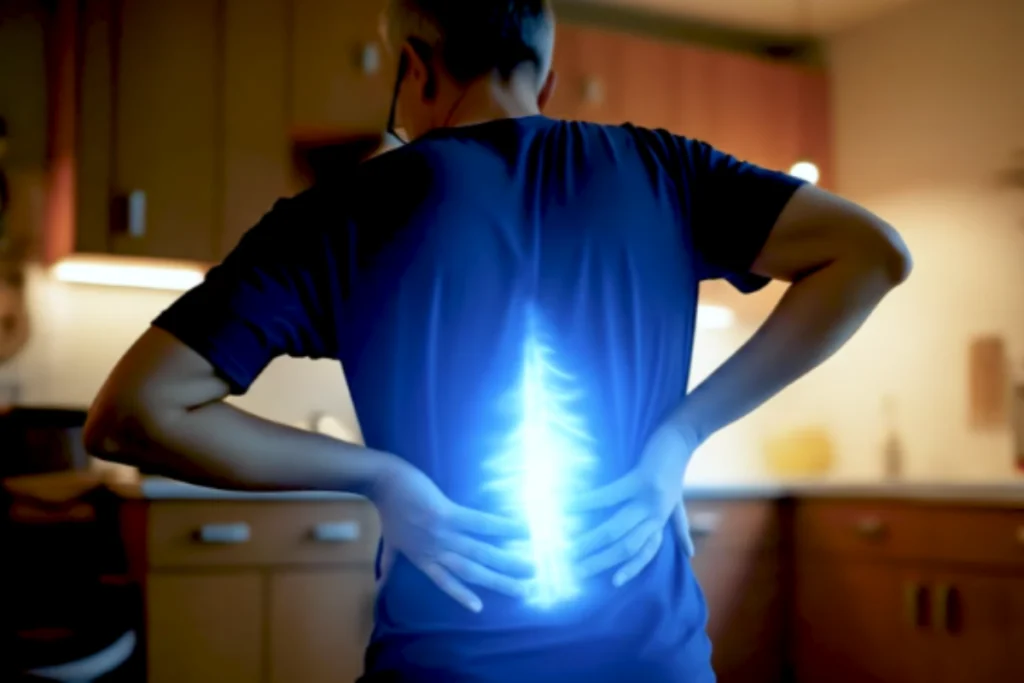
Herniated Disc Treatment: What to Do When the Disc Presses on a Nerve
Search Herniated disc treatment This usually happens when the pain is no longer felt “only in the back,” but starts to go down towards the buttocks, leg, or even causes tingling. In many cases, the most important thing is not to panic, but to understand the pattern: when the pain is mechanical, when there is nerve irritation, and what conservative steps usually help. If this pain is more like sciatica (because it runs down the leg), you can complement it with this specific article on ChiroDuo.
On this blog, you will find:
It means that a disc—specifically, a spinal disc—is pressing on a nerve.“
Typical signs of herniated disc sciatica
What to do if there is low back pain due to a hernia
When a Chiropractic treatment for a herniated disc It can be part of the plan (no unrealistic promises)
First: what is a herniated disc?
Between the vertebrae are discs that function as shock absorbers. A herniated disc occurs when part of the disc displaces or protrudes and can irritate nearby structures. Sometimes that contact or inflammation around it affects a nerve root, causing symptoms down the leg (what people often associate with “sciatica”). If you want a clear medical explanation of what a herniated disc is, what symptoms it can cause, and why it often improves with conservative management, you can review this resource from Mayo Clinic.
Important: Having a herniated disc on an image doesn't always mean pain. Many people have disc changes and don't have symptoms. What guides treatment is the clinical picture: symptoms, mobility, strength, and how the body responds to movement.
Herniated disc sciatica: typical signs
When nerve irritation is associated, the following may appear:
Pain radiating down to the buttock and leg, sometimes to the calf or foot
Tingling or numbness in leg or foot
Burning or electric shock-type pain“
Pain that worsens with prolonged sitting, driving, or bending over
In some cases, weakness (this requires more clinical attention)
A useful rule of thumb:
If the pain moves more towards the foot, it is usually a sign of greater irritation.
If the pain “centralizes” (stays more in the back or buttock and radiates less down the leg), it's usually a more favorable sign.
Low back pain from a hernia: what to do (step-by-step)
In most cases, initial management is conservative. The goal is not to “break the pain” forcefully, but to reduce irritation and regain function through progression.
- Avoid what triggers pain in the leg.
If there is low back pain due to a hernia with symptoms affecting the leg, it is advisable to pause temporarily:
Repeated deep flexion (bending forward a lot)
Lifting weights with a rounded back
Aggressive nerve stretches if they cause electric shock sensations
Intense traditional abdominal workouts if they increase pain - Maintain tolerable movement (no absolute rest)
Staying still for days usually increases stiffness and sensitivity. In many cases, it helps:
Short, frequent walks
Change posture every 30-60 minutes
Gentle movements within ranges that do not worsen symptoms - Regain mobility intelligently
It's not about “stretching for the sake of stretching.” With nervous irritation, the goal is to find movements that:
Don't increase the tingling
Don't carry the pain further down your leg
Allow to regain tolerance and control - Strengthen to stabilize (the part that prevents relapse)
When the irritation subsides, the next step is to build support:
Deep core stability
Glute and Hip Strength
Posture and load control for daily work
This is usually what really reduces relapses because the back stops overcompensating with constant fatigue.
Exercises: how to choose them if there are nervous symptoms
For a herniated disc with leg symptoms, the criteria are more important than the trendy exercises.
Rules of thumb:
If the exercise increases pain down the leg or increases tingling: adjust.
If mobility improves and the pain stays higher up: it's usually a good sign
A shorter daily routine is better than an occasional long session.
Chiropractic treatment for a herniated disc: when it can help
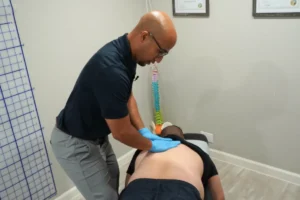
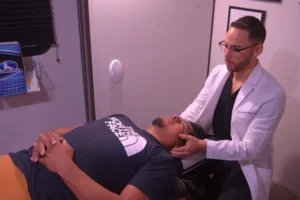
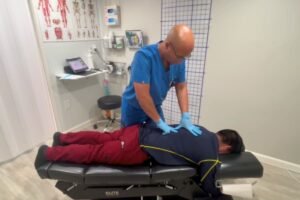
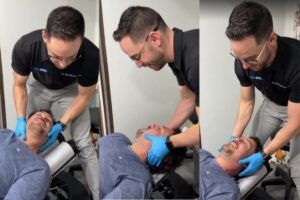
The Chiropractic treatment for a herniated disc it can be part of management when integrated into a comprehensive plan and adapted to the patient's pattern.
In general, it can be useful for:
Improve mobility with stiffness and mechanical restriction
Reduce mechanical pain and associated tension
Guide a progressive plan with habits and exercises (not just a one-off intervention)
The important thing is that the care is individualized and that there is clinical judgment to decide which techniques are appropriate, especially if there are symptoms radiating to the leg.
When NOT to expect (red flags)
Seek urgent medical evaluation if you experience:
Loss of bladder or bowel control
Marked progressive weakness in the leg
Numbness in the genital/perineal area
Severe pain with fever or after a strong trauma