
Your body has been sending you signals for a while now. Learn to read those signals before pain dictates to you.
There's a phrase we hear all the time in our practice: “Doctor, I need you to adjust my back – I feel like something is wrong.” What almost no one knows is that this feeling isn't an exaggeration or nerves. It's a real physical signal. And there's something even more surprising: most people who feel like “something is wrong” are right. They just don't know exactly what, or since when. That's what you're going to discover in this article.
“I need someone to crack my back”: What does that feeling really mean?
When you say “I need my back adjusted,” your body is describing something that in chiropractic is called Vertebral subluxationone or more vertebrae that have lost their normal position or mobility and are irritating nerves, tensing muscles, or compressing nearby tissues.
It doesn't always hurt badly at first. Sometimes it starts as discomfort, stiffness when you get up, a feeling that “something's not right.” That perception is more accurate than it seems: the nervous system detects structural changes before the pain is evident.
💡 To make it easy to understand: Imagine that your vertebrae are the links in a chain. When one moves out of place – even by a millimeter – the whole chain works differently. Muscles compensate, nerves get irritated, posture changes. Your body feels it. It's not making it up.
📚 Scientific evidence
A study published in The Spine Journal (2021) confirmed that asymptomatic vertebral subluxations—that is, misalignments that do not yet cause severe pain—alter muscle activation and overall posture in 64% of the cases evaluated. This explains why so many people “feel” that something is wrong before the pain becomes severe.
Misaligned Spine: Symptoms You Should Recognize
A misaligned back doesn't always scream. Sometimes it whispers for months before exploding. These are the most frequent — and most ignored — symptoms:
- One shoulder higher than the other When you look in the mirror or someone points it out to you, it can indicate mild scoliosis, asymmetrical muscle tension, or a misplaced thoracic vertebra.
- Pain that shifts location for no apparent reason Today your lower back hurts, tomorrow your neck. This migratory pain is a sign that the nervous system is sending signals from different levels of the spine.
- Feeling that one leg is shorter than the other Often it's not that the leg is shorter—it's that the pelvis is rotated. A pelvic imbalance can create this effect and cause hip and knee pain.
- Morning stiffness lasting longer than 10 minutes Waking up numb is normal for a few minutes. But if stiffness lasts longer than 10 to 15 minutes, or if there is joint inflammation or restricted mobility, it needs attention.
- Constant muscle fatigue with no clear reason When the spine is misaligned, muscles work twice as hard to compensate and maintain balance. The result is chronic muscle fatigue that doesn't improve with rest.
- Frequent headache starting in the back of the head Cervicogenic headaches—headaches that originate in the neck—are one of the most common symptoms of a misaligned cervical vertebra.
- Feeling the need to crack your back or neck The urge to “crack” your neck or back is a response to gas and pressure buildup in a joint with restricted mobility. If you feel this constantly, the joint is asking for professional adjustment.
- Numbness or tingling in arms or legs When a vertebra compresses a nerve, the electrical signal is partially interrupted. Tingling is the nervous system's way of warning that something is pressing on it.
Where do you feel the misalignment? — Most frequent areas
Brain (Head)
Headache, stiff neck, tingling in arms, mild dizziness.
Thoracic (mid-back)
Feeling of tightness, pain between the shoulder blades, difficulty breathing deeply.
⚡Lumbar (lower back)
Pain when sitting or standing up, sciatica, morning stiffness, hip pain.
🦴Sacrum / pelvis
Imbalance when walking, tailbone pain, feeling of a short leg.
Hip and knee
Pain coming from above — many knee pains originate in the pelvis or lower back.
Foot and heel
The plantar fascia and sciatic nerve connect the spine to the foot. Heel pain can originate from the spine.
“My back cracks and hurts”: Is this normal or a warning sign?
This is one of the most frequently asked questions we receive. Let's clarify the difference once and for all.
When is it normal for your back to crack?
The sound your back makes when you move—that “pop” or “crack”—is called Joint cavitation. It is the nitrogen gas from the joint escaping when the joint surfaces separate slightly. It is not dangerous in itself.
✓ Normal signs
- Cracking when you stretch in the morning
- The sound goes by itself, without forced maneuvering
- There is no pain before or after
- It happens occasionally
- You feel immediate relief
Alarm signals
- It thunders with sharp pain or burning
- You need to “snap” several times a day
- The clicking is accompanied by a feeling of catching.
- Tingling or numbness after
- The area remains sore for hours.
Cracking your own back offers momentary relief because it releases pressure in the joint. But It doesn't fit anything.. You can crack the wrong vertebra, fail to adjust the one that really needs to move, and over time, hypermobilize healthy joints while the problematic ones remain blocked.
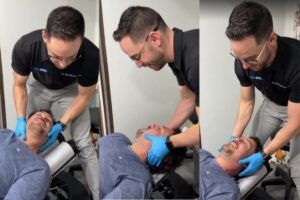
That's why the relief lasts minutes and you have to repeat it all day. A chiropractor adjusts the correct vertebra, in the correct direction, with the exact force needed.
«I used to crack my neck myself about 20 times a day. I thought it was helping me. When I came to ChiroDuo, the doctor explained that doing that was loosening the wrong vertebrae. They made the correct adjustment, and within two weeks, I didn't need to crack it anymore.» — Miguel A., ChiroDuo patient, North Carolina
Chiropractic Adjustment: Benefits that Go Beyond Pain
Many people believe that chiropractic adjustments are only for pain. The reality is more comprehensive than that. When the spine is realigned, the nervous system functions better—and that affects practically the entire body.
🎯
Drug-free pain relief
The adjustment reduces pressure on nerves and tissues, eliminating the cause of pain rather than just suppressing it with pills.
🔄
Mobility Recovery
Blocked vertebrae limit range of motion. Adjustment restores that lost motion specifically and safely.
😴
Better sleep quality
Nighttime pain and chronic muscle tension disrupt sleep. Patients report improved sleep quality starting from the first week of treatment.
⚡
More energy and less fatigue
When muscles stop compensating for poor alignment, the body expends less energy maintaining posture. The result is less daily fatigue.
🧠
Nervous stress reduction
Spinal manipulation reduces the activity of the sympathetic nervous system (the stress system), creating a calming effect that goes beyond the muscle.
🏃
Better physical performance
In physically active individuals, proper alignment improves coordination, balance, and resistance to repetitive strain.
📚 Scientific evidence
A review published in the Journal of Manipulative and Physiological Therapeutics (2019) analyzed 26 randomized controlled trials and concluded that chiropractic adjustment produces statistically significant improvements not only in musculoskeletal pain, but also in general quality of life, physical function, and reported stress levels in adult patients. The effects were superior to the control group both in the short term (4 weeks) and long term (6 months).
What happens on your first visit when you say, “I need my back adjusted”?
Many people have never been to a chiropractor because they don't know what to expect. Here's the complete process, no surprises:
Medical history in Spanish
We'll ask you where it hurts, since when, what makes it better or worse, if there was an accident or intense physical labor, and what medications you take. No rush. In your language.
Spine physical examination
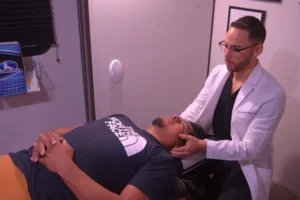
We evaluate your posture, mobility, tension points, and neurological reflexes. We compare both sides of the body to detect asymmetries.
X-rays if necessary
For cases of trauma, chronic pain, or suspected structural conditions, X-rays allow us to see exactly what is happening in the spine.
Clear and honest diagnosis
We'll explain what we found, why it's happening, and what your options are. If your case requires another specialist, we'll tell you straightforwardly.
First fitting (if safe to do so that day)
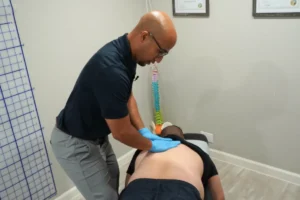
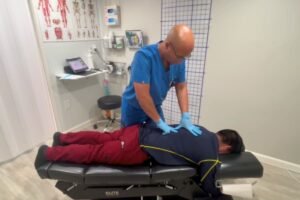
In most cases, the first adjustment is made during that same visit. It is a controlled, precise movement in the correct direction and to the correct vertebra.
Personalized treatment plan
We'll tell you how many visits we estimate you'll need, how often, and what you can do at home to speed up your recovery.
If you feel like your back needs adjusting, it's time.
At ChiroDuo, we give you a complete evaluation, in Spanish, without rushing, and with honesty. Find out what's happening with your spine and what can be done about it. Schedule your ChiroDuo evaluation →